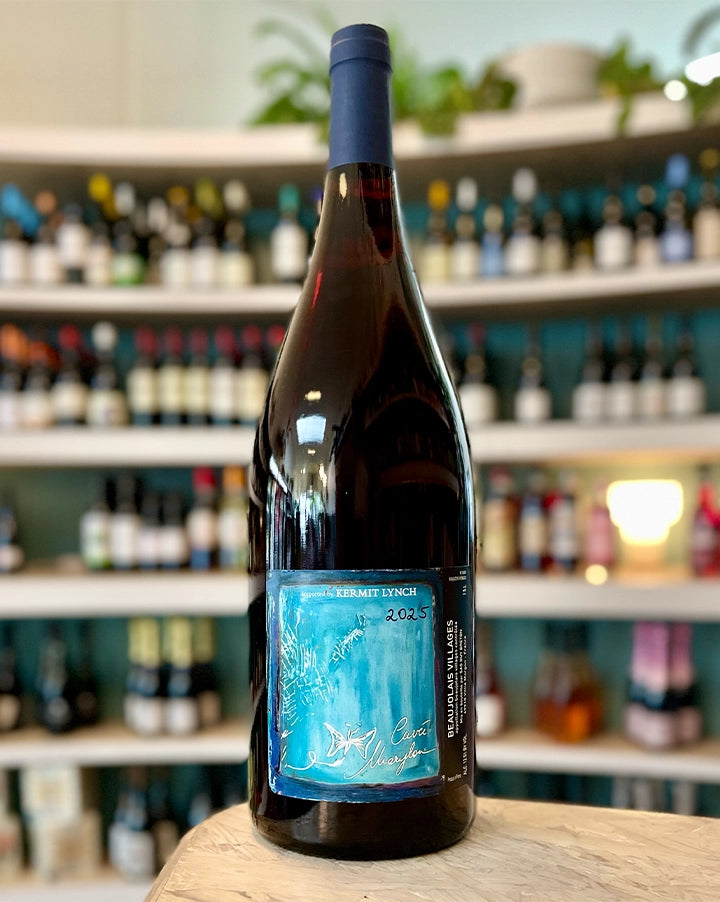
Guy Breton 'Cuvée Marylou' 2025 Beaujolais-Village MAGNUM
Guy Breton 'Cuvée Marylou' 2025 Beaujolais-Village MAGNUM
1500ml bottle
12.5% abv
Floral and delicate on the nose, with fresh raspberry & strawberry notes. Light on its feet with low tannins, juicy acidity, and a delicately spicy, mineral finish. Fresh, light, super clean, zero funk.
Sourced from the Saint Joseph and Grand Cru subzones of the appellation, about 500 meters from Breton's Morgon vines. Only indigenous yeasts are used. Grapes are cooled to 5-6° C after harvest to begin fermentation at low temperature. 100% whole-cluster fermentation. Short macerations in tank; length of maceration is determined by tasting. Grapes are pressed and racked to barrel before the end of fermentation. Tiny doses of sulfur added during élevage and at bottling. Bottled unfined and unfiltered. The wine is named after Marylou, Guy Breton’s daughter.
Guy Breton is known by his friends as P’tit Max—though he is anything but petite. He took over the family domaine from his grandfather in 1986. Until that point, the family was selling their fruit to the large cooperative wineries which dominated the region and were gravitating towards a uniform style. The rise of imported yeast cultures to impart flavor and aroma, the use of high-tech carbonic maceration, and the widespread commercialization of Beaujolais Nouveau debased the region’s reputation, and Beaujolais came to be seen as one-dimensional, lacking any expression of the native terroir.
Following the example of traditionalist Jules Chauvet, Guy and three other local vignerons, Marcel Lapierre, Jean-Paul Thévenet, and Jean Foillard, soon hoisted the flag of this back-to-nature movement. Kermit dubbed this clan the Gang of Four, and the name has stuck ever since. The Gang called for a return to the old practices of viticulture and vinification: starting with old vines, never using synthetic herbicides or pesticides, harvesting late, rigorously sorting to remove all but the healthiest grapes, adding minimal doses of sulfur dioxide or none at all, and refusing both chaptalization and filtration. The end result allows Morgon to express itself naturally, without make-up or plastic surgery: rustic, spicy, loaded with schist minerals, refreshing, and deep-down delicious.
Breton’s domaine is comprised of just over four hectares (10.6 acres), most of which lies in the appellation of Morgon, above the village of Villié-Morgon. He supplements his own harvest with purchased fruit from surrounding appellations, enabling him to vinify a diverse portfolio of Beaujolais crus. His own vineyards, which exceed a century of age in some parcels, are located in the Morgon climat “Les Charmes”, primarily in the high-altitude lieu-dit “Saint-Joseph,” where slow ripening allows for low alcohol and great freshness in the wines. Max is among the first in the region to start picking each year, cooling down his harvest and pressing before the end of fermentation to craft wines he likes to drink: bright, aromatic, low in tannin, and dangerously easy to quaff down to the last drop. – Importer's notes
More importer's notes:
Perhaps no one embodies the paradoxes of the Beaujolais as much as Guy Breton. In this region that has become synonymous with “natural wine” – thanks in large part to Guy and some of his contemporaries – the bottles that are often the easiest and most pleasurable to drink are those made with the most relentless attention to detail. Similarly, if you looked no further than Breton’s movie-star good looks, laid-back demeanor, and the ambrosial nature of his reds, you might easily miss the painstaking seriousness of his practices in Villié-Morgon.
The particular magic of Guy’s wines, for me, is that they ride a thrillingly fine line between his unmistakable house style on one side and the character of each of his terroirs on the other. Not many vignerons can achieve maximum expression of the self and of the place, but Guy does exactly that.
In his flagship Morgon, old vines and sandy, high-elevation slopes bring a certain regal plushness to his otherwise bright and featherweight Gamay. In the Régnié, Guy taps into the shallow soil to draw out the grape’s slightly more taut and tense side, balancing out vibrant fruit and floral aromas beautifully. In his Côte de Brouilly, you still find the cru’s trademark stoniness, but it’s wrapped in silk. The Fleurie leans towards the opulent end of Breton’s range, but even so, in his hands, it still abounds in velvety finesse.
Finally, if ever there was a Beaujolais cru that was made for Guy Breton, it might be Chiroubles. At the highest point among the region’s ten crus, the vines in Chiroubles ripen ever so slowly and evenly, yielding some of Beaujolais’ most floral and high-toned reds. Already well versed in working such terroirs, he jumped at the opportunity to make wine from a small plot of Chiroubles about ten years ago. This land is a perfect match for his inclination toward lithe and ethereal Gamay
Share