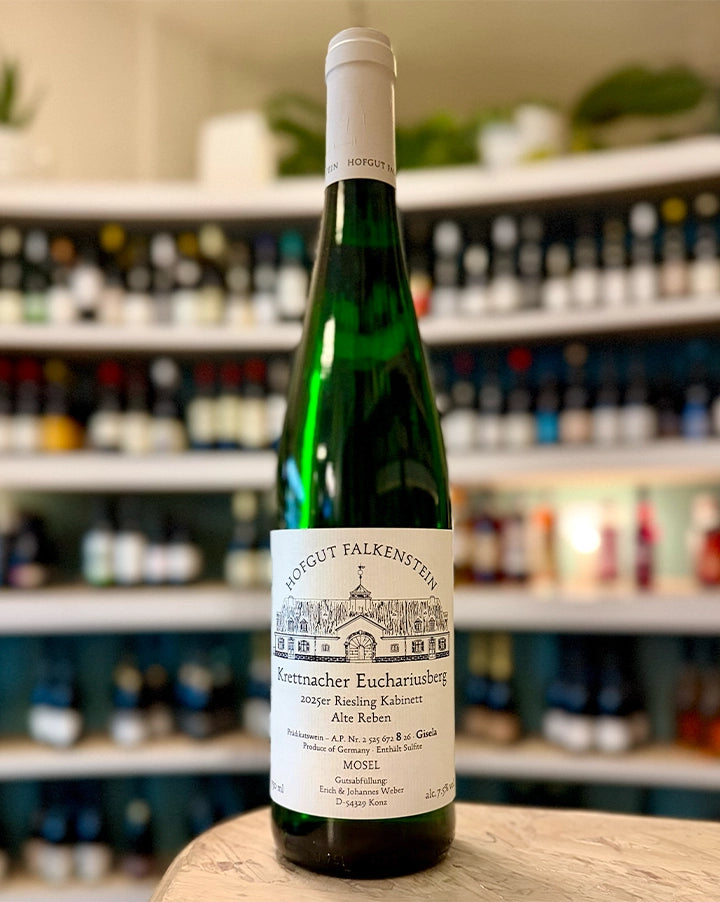
Hofgut Falkenstein 'Krettnacher Euchariusberg' 2025 Riesling Alte Reben Mosel
Hofgut Falkenstein 'Krettnacher Euchariusberg' 2025 Riesling Alte Reben Mosel
750ml bottle
7.5% abv
Fuder Gisela (AP 8) is off-dry, spicy, tart, chalky, and cut. Silky, creamy, citrusy, and sprightly. Delicate but already layered stony-mineral and citrus aromas. A touch of SO2 showing but will blow off. Tastes a good deal sweeter than their Meyer Nepal 2025, pure lemon fruit, juicy and intense. Extremely persistent.
Erich Weber of Hofgut Falkenstein makes ultra-traditional, dry-tasting Saar Rieslings. He likes to call himself Winzer Weber (winzer is German for winegrower). In other words, the emphasis is on the work in his vineyards, where he spends most of his days. With his tan and rugged face, he looks the part, too. Since his middle son, Johannes, has joined him full-time, there has been more of a focus on Rieslings with residual sugar. In recent years, their wines have also caught the attention of critics, both in and outside Germany.
Erich and Johannes let ambient yeasts ferment the musts in old oak casks in a deep, cool, and damp cellar with moldy stone walls, and most of the wines end up either naturally dry (trocken) or off-dry (feinherb). Hofgut Falkenstein, therefore, is one of the rare Saar producers that specializes in distinctive, bracing, light, dry or dry-tasting Rieslings, bottled traditionally by the cask. The bone-dry Rieslings are brisk. All the wines have a ripe, racy, and well-integrated acidity from low yields and old vines. The key is a good grape.
The AP numbers (with the bottling or batch number in a large, bold print) specify the exact cask, or Fass, which, for the most part, is nicknamed after the former owner of a given parcel; a few casks are named after old site names or place names, such as Auf dem Hölzchen – which, like Ober Schäfershaus, is in the prime Silberberg sector of “Crettnacherberg” – or Im Kleinschock, marked as “Schock” on Clotten’s 1868 “Viticultural Map of the Saar and Mosel.” Depending on the size of the parcel and the yield of the vintage, some casks are from two or more parcels in a given sector, which the Webers harvest en bloc, or all at one time. There needs to be enough for one press load. Most of the wines come from old vines.
The Webers do not chaptalize or deacidify any of their wines, including trocken and feinherb. Thus, they classify all of these as Prädikatsweine, which were all called Naturweine, or “natural wines,” pre-1971 Wine Law. They also avoid cultured yeasts and yeast nutrients. That’s why so few of their wines fermented dry in the 2018 vintage. The Webers never use artificial fertilizers. Instead, they use cow dung. In the cellar, they eschew enzymes, fining agents (such as bentonite and charcoal), cultured yeasts, thiamine (vitamin B1), and diammonium phosphate (DAP). They don’t even have a chamber filter press to filter the dregs after sedimentation. Instead of hiring a contract bottler, the Webers prefer to bottle their wines themselves, cask by cask, straight off the gross lees. They do not pump, rack, or filter the wine beforehand. They use a sterile pad filter during the process but eschew a vacuum pump and an absolute cartridge membrane filter. They also never inject carbon dioxide, such as Carbofresh, into the wine during the process. Their wines have a natural spritz that is preserved in the bottle. – Lars Carlberg
Most of the Saar's famous hillsides face south. The Krettnacher Euchariusberg mostly does not. Its roughly 36 hectares stretch from Obermennig to Krettnach in the Konzer Tälchen, a side valley east of the Saar, and the bulk of the slope faces west to west-southwest, catching the afternoon and evening sun rather than the midday blast. In a cold valley that slower, later warmth stretches the season and keeps acidity high. The soil is deep gray-clayey slate mixed with quartz and quartzite-bearing sandstone, which gives the vines water to draw on in dry spells. Hofgut Falkenstein farms about 2.3 hectares here, and this Riesling from the Saar is as clear a picture of the Tälchen as the estate bottles.
Erich Weber is a Krettnach native, and the Euchariusberg sits at the core of what he built at Hofgut Falkenstein alongside his son Johannes. Their farming is where the style starts. Each vine is pruned to one short flat cane to hold yields down. Grasses grow between the rows, and there are no herbicides, systemic fungicides or synthetic fertilizers. The Webers also avoid stripping leaves during warm months, reasoning that exposed bunches sunburn and build thicker skins, which push Riesling toward the petrol character they do not want. Harvest is by hand, parcel by parcel. In the cellar each Fuder is nicknamed for a former owner of the plot it holds, and collectors follow those names from vintage to vintage.
Share