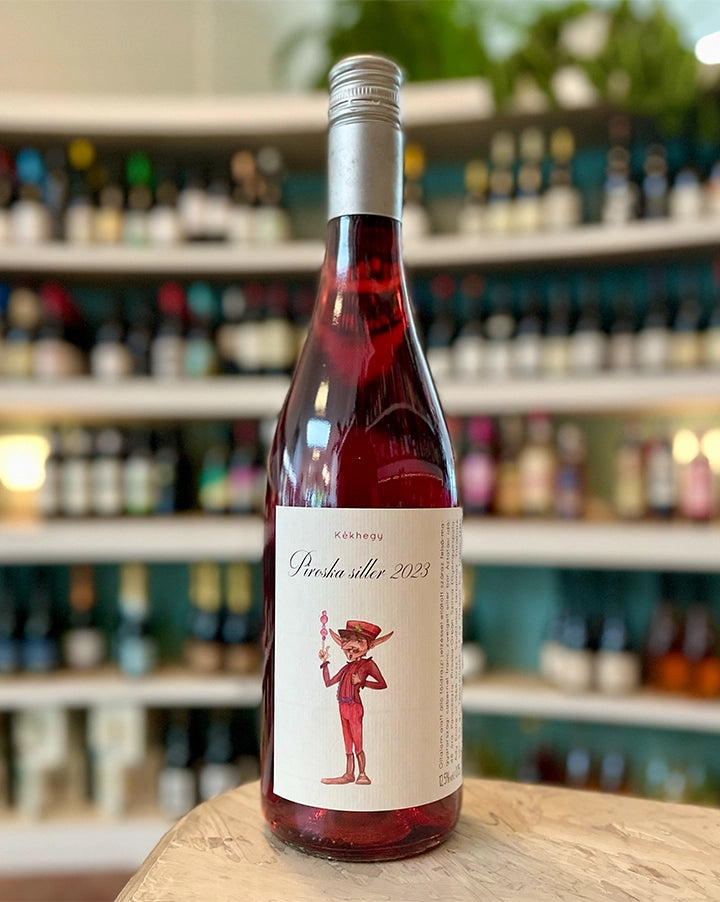
Kékhegy 2024 Siller Matra, Hungary
Kékhegy 2024 Siller Matra, Hungary
750ml bottle
13.5% abv
"We are always looking for a good Siller. This style is essentially somewhere in between a light red and a rosé. It’s also a perfect foil for traditional flavors like Paprika and Caraway. It’s what Tibor and Szilvia would call a “smart rosé,” in that it has some grip from some light maceration along with plenty of aromatics and freshness. It’s also picked in two stages to get the full range of ripeness. 50% of the fruit was crushed and spent two days on the skins in open vats while the other half got a head start on fermentation in tank. Both fractions were blended and finished fermentation in tank before being bottled unfiltered." – Importer's notes
GRAPE COMPOSITION: Cabernet Sauvignon
SOILS: Andesite, red clay, and chalk
MACERATION & AGING: Two-thirds is Kékfrankos fermented like a Rosé then blended with with whole cluster.
RESIDUAL SUGAR: 0.6 g/l
ACIDITY: 5.4 g/l
2009
Continental
170-200m
Volcanic hills
Tramini, Zöld Veltelini, Szürkebarát, Cabernet Sauvignon, Cabernet Franc, Blauburger, Zweigelt
3 hectares
Natural
One of my favorite Hungarian colloquialisms is, “Sírva vigad a Magyar.” This more or less translates to: a Hungarian is only happy when they are miserable. I’ve also heard it described as a “melancholic intermingling of joy and sorrow.” This sentiment is also acutely felt while walking around the various Pincefalu in the Mátra appellation. A Pincefalu is a village dedicated entirely to small family cellars dug into the hillsides with a connected press house on top and often a small living space above that. While largely abandoned today (WWII, Holocaust, Communism etc…), you can easily close your eyes and imagine what harvest would have been like here at its historical peak in the late 1700s early 1800s. Hundreds of families all cooking, harvesting, and celebrating together. While only a handful of these cellar houses are still actively used by hobby winemakers today, a few families are doing something really special and bringing these wines to the market like Szilvia and Tibor of Kékhegy Pince in Gyöngyöspata.
Vineyards
Last year they only sprayed twice (sulphur, orange-oil, potassium-hydrogen-carbonate, amino-acid based biostimulant, humic-acid preparation), made one deep tillage followed by healthy and diverse cover crops. They tried zero till for 4 years between 2015-2018, but the volcanic soils proved to be too thick and dense. They’ve since finally found a great balance and continue to experiment.
The Siller comes from the Katona-berek dűlő just south of the village of Szűcsi overlooking a small lake. Their plot is just .55 hectares on the south-eastern side of the hill. The soil is clay with andesite tuff. There’s remarkable and ever present airflow here and it’s warm enough to afford a long growing season for the Cabernet Sauvignon. The acids are ripe and there ripeness with remarkable aromatics.
Winemaking
In the cellar, most wines are open vat fermented, basket pressed, and often aged in tank. Most grape material is moved by hand and instead of pump overs or higher extracted punchdowns, most maceration is done by hand as well. The only addition to their wines is SO2, but they don’t want to set their pick date or predetermine their winemaking style in the service of needing less of it. They have no interest in high VA, green acids, or relying on extensive lees aging to add body. They don’t want to lose the grape in the process either. Most wines have around 30-60ppm and are bottled unfiltered. They are experimenting and pushing themselves with some zero-zero stuff down the road, but there’s no rush.
Share