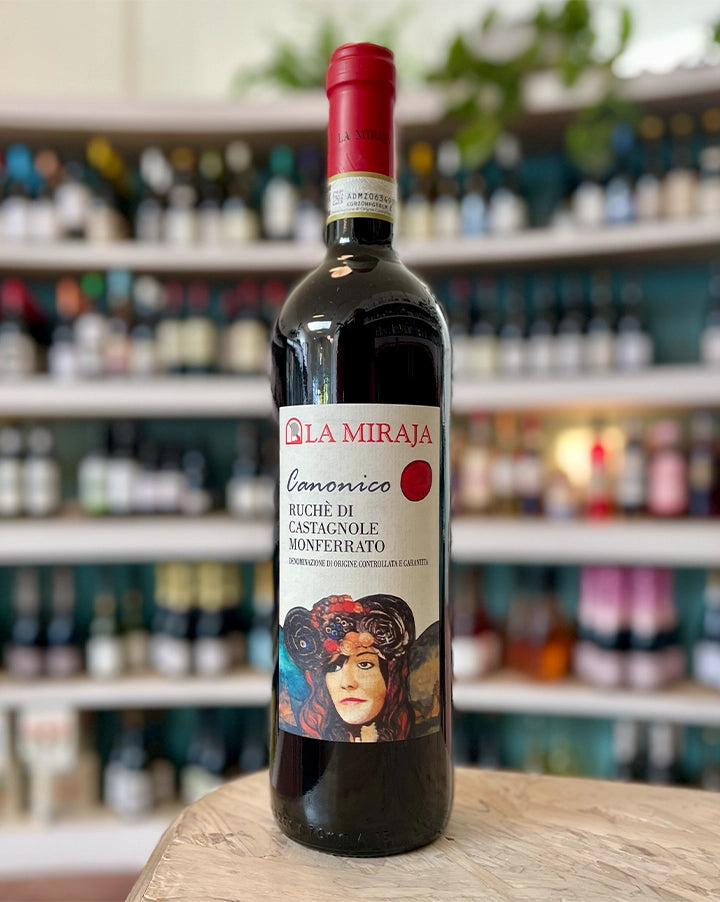
La Miraja 2023 Ruchè di Castagnole Monferrato Piemonte
La Miraja 2023 Ruchè di Castagnole Monferrato Piemonte
750ml bottle
14% abv
Translucent red. A wild nose of violet, rose, iris, jasmine, cardamom, white pepper, and (surprisingly for a red wine) lychee. The palate shows perfectly ripened, bright red berries, robust acidity, and moderate tannins. Singular, beguiling, fantastic.
Hand-harvested fruit is destemmed and then crushed by basket press into stainless-steel tanks, where it remains in contact with the skins for 10 days while native fermentation occurs. Following spontaneous malolactic fermentation, the wine rests in cement vessels for 3 months and then an additional 4 months in bottle prior to release.
Pairs well with charcuterie and medium-aged cheeses as well as the classic Piedmontese dish bagna càuda. This wine also pairs brilliantly with mild South Asian cuisines, curry dishes, grilled meats, and burgers.
La Miraja is nestled within the original castle of Castagnole Monferrato, constructed in the 11th century and retrofitted to serve as a cellar in the 1400s. In this armory-turned-cellar, Eugenio Gatti turns out Barbera d’Asti, Grignolino, and his fabled Ruchè. A seventh-generation viticulturist, Eugenio personally tends to the oldest vineyard of Ruchè in Castagnole Monferrato. It is here that Eugenio Gatti devotes his life’s work to producing 840 transcendent cases of wine each year.
Castagnole Monferrato holds the illustrious honor of being the birthplace of Ruchè. This grape is a unique red variety found primarily in the rolling hills northwest of the town of Asti, where only seven villages hold the distinction of producing wines under the DOCG.
Ruchè di Castagnole Monferrato is one of Piemonte's newer DOCG titles, introduced during the extensive administrative revisions of 2010 and 2011. This followed the interest that was first piqued in 1987 when the Ruchè grape, a relative obscurity until that point, was awarded a dedicated DOC among the Monferrato hills.
The catchment area for the title covers seven communes in the Asti province. These are Grana, Montemagno, Portacomaro, Refrancore, Scurzolengo, Viarigi and the Castagnole Monferrato which gives the DOCG its name.
All are found in the rolling hills just north-east of Asti town. The altitude at which vineyards sit varies due to the topography, but the average lies somewhere between 180 and 215 meters (600ft and 700ft) above sea level.
All Ruché di Castagnole Monferrato wines must be made from at least 90 percent Ruchè grapes; the remaining 10 percent is left open to any combination of Barbera and Brachetto. This produces a fragrant, slightly floral wine whose pale red color belies its tanic profile and depth of flavor when well made. Notes of tart berries and sweet spices are also associated with the wines. This upfront style is complemented by tart acidity, which the grape variety retains in all but the very hottest of growing seasons.
Ruchè, which is named Ruché, Rouchet or Rouché in France, or sometimes Rouche or Roche in Italy, is something of an enigma, even in Piemonte. There are conflicting tales of how it arrived in the region's vineyards: some say it is an indigenous vine, some believe it was brought there from France.
Whatever the truth, Ruchè vines have been grown and used to produce wine in Piedmont for hundreds of years, although the wines have only just begun to make their way outside the Monferrato area. At the dawn of the new millennium there were just 50 hectares (125 acres) of Ruchè planted, making this one of the most exclusive wines made under any Italian wine title, DOC or DOCG.
Share