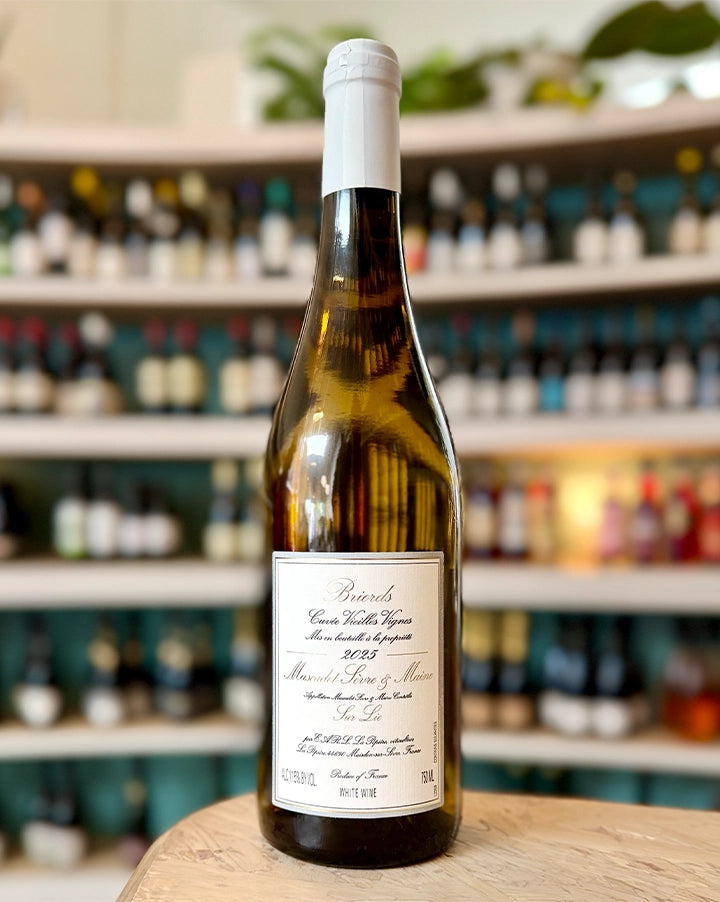
La Pépière 'Clos de Briords' 2025 Muscadet Sèvre et Maine sur lie
La Pépière 'Clos de Briords' 2025 Muscadet Sèvre et Maine sur lie
750ml bottle
12% abv
Lemon, pear, lees, and ocean-side salinity. Elegant, light, & bright.
100% Melon de Bourgogne
Farming certified organic, in conversion to biodynamics. Harvested by hand. Whole-cluster pressing. Spontaneous fermentation with native yeasts in stainless steel. Aged nine months sur lie in large underground tanks. Bottled unfined and unfiltered.
First produced in 1988, this great Muscadet is made from a three hectare parcel of old massale-selection vines (all over 60 years old, with a high percentage much older) on a slope above the Maine. The bedrock is Granite de Château Thébaud, a fissured rock that allows the vines to penetrate deeply, with ideal thin topsoils of clay, with sand and gravel allowing good drainage.) Having enjoyed this wine in every vintage produced, I can safely say that 2025 is a wonderful year for Briords, lacking only the higher acidity of 1996 and 2014, for example, to put it in the very top rank. Tasted last February in France, the wine showed beautiful aromas of white flowers, white fruits, citrus and - if you could smell it - granit. The palate is quite round and ripe, at this point showing more fruit than terroir, but the minerals are certainly there along with complex herbal, citrus and stone flavors that continue in the round but nicely bright and bitter finish. Try to give this wine 10 years in the cellar, but chances are you'll drink it all much sooner. – chambersstwines.com
Domaine de la Pépière was founded by Marc Ollivier in the 1980s and became one of the most important estates in the history of Muscadet's modern reputation, alongside Jo Landron, Guy Bossard, and the Luneau-Papins, Ollivier was central to demonstrating what serious, terroir-driven Muscadet could be. In 2019 Marc stepped back, handing the domaine to his protégés Rémi Branger and Gwénaëlle Croix, who have maintained the standard. The estate is based in the Clisson cru and farms several of the appellation's most respected parcels, each vinified to express its individual geology (granite, gneiss, gabbro) rather than a house style.
Share