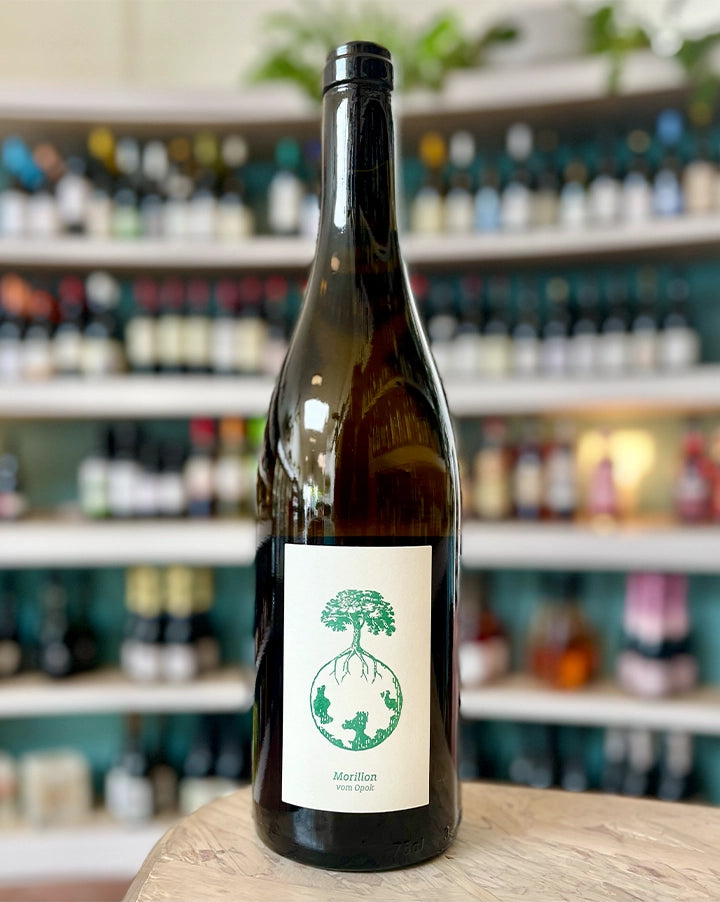
Werlitsch 'Morillon vom Opok' 2022 Chardonnay Styria, Austria
Werlitsch 'Morillon vom Opok' 2022 Chardonnay Styria, Austria
750ml bottle
12.5% abv
Mouthwatering acidity and freshness, with green apple, quince, honesuckle, and mint. A unique expression of Chardonnay.
100% Morillon (Chardonnay), biodynamically farmed and following natural winemaking principles in the cellar.
Gamlitz, Südsteiermark, southern Austria, near the Slovenian border. Limestone-rich Opok marl soils, steep and rolling hillside terrain. Mid-elevation parcels, same site as the Sauvignon Blanc Vom Opok. Morillon is the local Styrian term for Chardonnay, used throughout the region to distinguish local plantings from internationally marketed Chardonnay.
Hand-harvested. Destemmed, direct pressed without sedimentation, juice transferred to barrel the following day including cloudy portions. Spontaneous fermentation with native yeasts. Aged 12 to 18 months in large, old oak barrels before bottling. No fining, no filtration. No added SO2.
Ewald Tscheppe farms 8 hectares of steep and rolling hillside in Gamlitz, South Styria, under Demeter certified biodynamic principles. No sulfur added in any Ex Vero cuvée. No fining, no filtration. All wines spend 2 years on lees in large old oak barrels before a further year in bottle prior to release. Spontaneous fermentation with brief skin maceration before pressing. Malolactic fermentation occurs naturally. Ewald is a founding member of the Schmecke das Leben group alongside his brother Andreas Tscheppe, Franz Strohmeier, and Sepp and Maria Muster. He was among the first producers in Styria to work with skin contact and zero sulfur additions, beginning this journey before it became fashionable anywhere in Austria.
The Vom Opok Morillon is the Chardonnay counterpart to the Sauvignon Blanc Vom Opok, produced from the same mid-elevation limestone-marl parcels with identical winemaking. Both sit below the Ex Vero series in aging time (12 to 18 months versus 2 years) and are single-variety rather than blended. Ewald's stated goal is to produce Styrian whites of precision and mineral depth, rather than the fruit-driven, reductive style that dominated the region before his generation's shift toward natural winemaking.
Share